Managing payroll for complex timesheets is one of the biggest operational challenges for modern businesses. From multiple pay rates to overtime rules and compliance requirements, even small errors can quickly escalate. This guide explains how payroll for complex timesheets works, where errors occur, and how modern systems solve these challenges.
In this article, we’ll cover:
- What are complex timesheets?
- Common payroll challenges
- Compliance risks
- Why traditional payroll fails
- How modern systems solve this
- Key features to look for
- Best practices
- Implementation guide
- FAQs
Why complex timesheets create payroll challenges
Payroll should be simple. Employees work, hours are recorded, and people get paid.
But payroll for complex timesheets is rarely that straightforward. Complex timesheets, multiple pay rates, shift allowances, overtime rules, and award interpretations introduce compounding problems at every stage of the payroll cycle. And when time & attendance data has to be manually transferred into payroll, the risk of errors compounds. Data gets re-keyed, corrections don't make it across, and by the time payroll runs, the numbers may no longer reflect what actually happened.
The more complex your workforce, the greater the risk.
Getting time data into payroll accurately, and without manual handling, is the difference between a smooth payroll process and constant rework. With TimeFiler, clock-ins, digital timesheets, and rosters feed directly into payroll. That means what flows into payroll is clean, compliant, and ready to process. No manual re-keying, no guesswork.
This guide breaks down where timesheet complexity comes from, how it impacts payroll accuracy, and what a better approach looks like.
What are complex timesheets?
Complex timesheets go beyond simply recording a start time, end time, and break. They capture the real-world complexity of how modern employees work and how they need to be paid.
A complex timesheet typically includes multiple variables that affect pay, such as different pay rates, overtime thresholds, allowances, and leave interactions. These variables must be interpreted correctly to ensure employees are paid accurately and in line with contractual and legal requirements.
For example, some roles require additional compensation based on working conditions. An employee working at height, across multiple job roles, or in different locations may be entitled to different rates or allowances depending on when, where, and how they work. Payroll systems need to accurately capture and apply these variations. For businesses operating under collective agreements or individually negotiated terms, that means the system must be flexible enough to reflect what has actually been agreed, whatever form that takes.
Complex timesheets arise when any of the following conditions are present:
Any one of these adds complexity. Most payroll managers deal with several at once, and every additional variable increases the risk of payroll errors.
Common workforce scenarios that create timesheet complexity
Understanding where complexity comes from is the first step to reducing payroll errors. In most organisations, complexity isn’t caused by one issue, but by multiple scenarios happening at the same time.
These are the payroll situations that most often create challenges:
Employees working multiple roles
When an employee takes on multiple roles, departments, or jobs, their time needs to be allocated correctly to ensure accurate pay and cost tracking. For example, someone working as both a personal trainer and an administrator needs different pay rates applied to different hours. Without clear visibility, errors in pay and reporting are common.
Shift workers and penalty rates
Rostered staff working evenings, weekends, public holidays and shifts crossing midnight on public holidays may be entitled to penalty rates depending on their contract conditions. Manually identifying and applying the correct rate to each shift is time-consuming and error prone.
Overtime that spans days or weeks
Overtime rules often vary, some are calculated daily, others weekly, and some combine both. Tracking when thresholds are reached and applying the correct rate from that point forward is difficult to manage manually, especially across large teams.
Staff with irregular hours
Casual employees and variable hours staff often work split shifts, pick up last-minute changes, or have hours that vary significantly week to week. Without accurate data capture, their timesheets are frequently incomplete or incorrect by the time payroll is processed.
Leave mixed with worked hours
When employees take partial-day leave or different leave types within the same pay period, payroll calculations quickly become more complex. Leave payments, entitlements and hours worked all need to be reconciled correctly.
Multi-site workforces
Employees moving between locations may be subject to different pay conditions, allowances, or cost centres. Consolidating that data accurately - especially without a centralised system, is a persistent challenge.

Wellington City Mission
To see how this plays out in practice, explore how using TimeFiler helped Wellington City Mission with its payroll complexity.
Compliance risks in time-based payroll
When payroll relies on inaccurate or incomplete timesheet data, the risks go beyond operational inefficiency. For NZ businesses, payroll errors can quickly become legal and financial liabilities.
Time and underpayment/wage theft:
The compliance risk runs in both directions.
Underpayment, even when unintentional, can be considered wage theft under the Crimes (Theft by Employer) Amendment Act 2025. With increasing regulatory scrutiny and stronger penalties, payroll errors are no longer just an administrative issue, they carry legal consequences.
At the same time, overpayment can occur through “time theft”, where employees clock in early, clock out late, or record hours not worked. Without accurate, real-time visibility, these issues can go unnoticed and inflate payroll costs over time.
Employees have an obligation to ensure they capture their time correctly. Employers have an obligation to ensure employees are getting paid correctly. If both do this, then both parties are acting in accordance with the law.
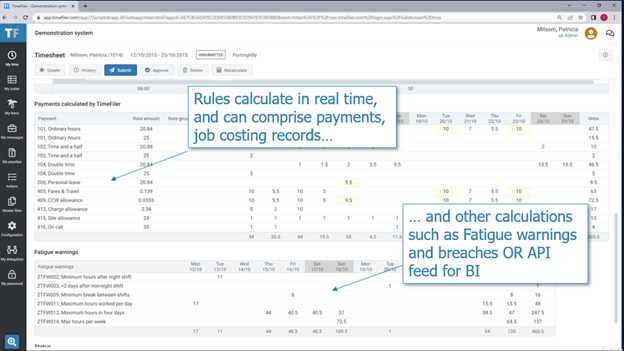
Capturing time data in real time helps both parties reduce risks. With TimeFiler's real-time clock-in functionality, businesses can see exactly when employees are working, flag anomalies early, and resolve discrepancies before they impact payroll.
Record-keeping obligations:
NZ law requires employers to maintain accurate pay records for at least 6 years. Incomplete, inconsistent, or manually compiled timesheet records are difficult to defend if a dispute or audit arises. A centralised system that records every clock-in, edit, and approval creates a clear audit trail and reduces exposure.
The Employment Leave Bill will also increase the need for accurate time & attendance data:
Proposed reforms under the Employment Leave Bill aim to simplify how leave entitlements are calculated and paid, including a new test for determining whether a public holiday is an otherwise working day for employees without fixed days of work specified in their employment agreement.
However, simplification does not remove the need for accurate data. Employers will still need accurate records of hours worked, leave taken, and pay components to apply the rules correctly.
For businesses with fluctuating rosters, overtime, or allowances, the quality of time & attendance data remains critical. A robust T&A system like TimeFiler ensures leave accruals, balances, and payments are calculated consistently and supported by clear records if questions arise later.
Why disconnected payroll and time & attendance systems create problems
Most payroll systems were built to process pay, not to manage the complexity that sits upstream of it. That gap is where problems start. When time & attendance data isn't connected directly to payroll, the system has to rely on data that arrives manually, late, or incomplete, and that's where errors take hold.
Disconnected systems rely on clean data that rarely arrives:
Traditional payroll systems assume the data coming in is accurate and complete. In reality, timesheets are often collected manually, via spreadsheets, or through disconnected systems, meaning the data arriving at payroll is anything but clean.
Manual data entry creates risk at every step:
Re-keying timesheet data into payroll is one of the most common sources of payroll errors. It's slow, repetitive, and introduces mistakes that are often only discovered after employees have already been paid.
Not built for modern workplaces:
Casual staff, multi-site operations, and employees working across multiple roles are now the norm. Legacy systems were built for fixed hours, and simple pay structures weren’t designed to handle this level of variability.
Lack of real-time visibility:
In traditional workflows, payroll issues are often only discovered after the pay run.
Without live data flowing from time capture through to payroll, there's no opportunity to catch and correct issues before they become problems.
The result is a reactive payroll process, where teams are constantly fixing errors instead of preventing them.
This is why the connection between time & attendance and payroll is critical. Systems like TimeFiler and TimeFiler Payroll are designed as a connected solution, so complexity is handled at the point of capture, not discovered at the point of payment.
So, what does that approach look like?
How modern SaaS payroll systems solve these challenges
The difference between modern and traditional payroll comes down to where the work happens.
To deliver real-time processing and capture data at the source, you need a modern, web-native payroll platform. While SaaS alone doesn’t guarantee a system is modern, it’s a strong indicator.
In traditional workflows, payroll issues are often only discovered after the pay run.

Smart timesheet automation
To delve deeper into this topic, explore TimeFiler’s article about smart timesheet automation.
Modern payroll systems are built to connect directly with time & attendance, so what flows into the pay run is already clean, verified, and ready to process.
When TimeFiler feeds directly into TimeFiler Payroll, there's no manual re-keying and no transcription errors. What's captured is what gets paid.
Real-time visibility:
Exceptions and missing entries are flagged before the pay run, not during it. Problems are caught early, not discovered after employees have already been paid.
Built for complex workforces:
A connected time & attendance and payroll solution is designed to handle:
- Casuals and variable staff
- Rotating rosters
- Multi-site operations
- Employees across multiple pay rates
Audit-ready records:
Every clock-in, approval, and calculation is recorded and traceable, so when a compliance question arises, the data is there.

Confidence: How TimeFiler helped six highly complex NZ industries

Holidays Act NZ: Stay compliant before & after the Employment Leave Bill